



Tuareg
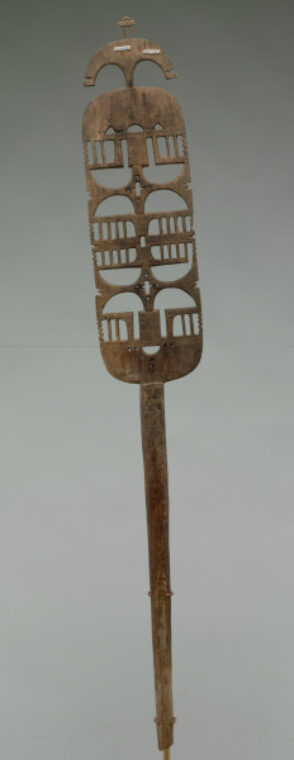
Baggage Stand (Ehel)
Tuareg, 1900-1999
Scroll

Tuareg
Baggage Stand (Ehel)
Tuareg, 1900-1999
Physical Qualities
Wood, aluminum alloy, 123.5 H x 17.9 W x 3.5 D cm.
Credit Line
Arts of Africa, the Americas, Asia & Pacific Islands Acquisition Fund
Object Number
1999.175
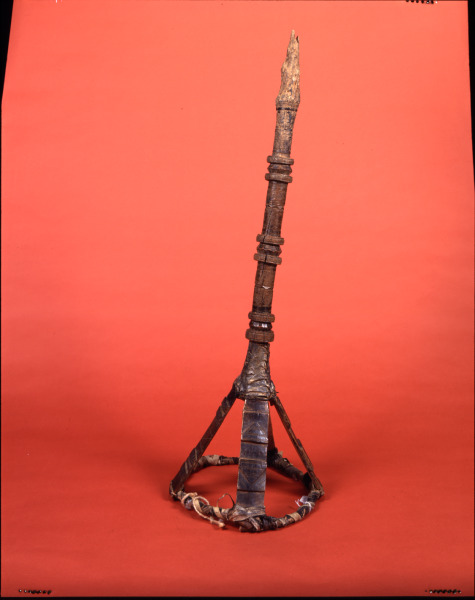
Carefully delineated geometric openwork characterizes Tuareg architectural arts. The fine lines of this pole served not only to beautify the interior of a tent, but also to hold luggage and clothes and support mat walls. It could also be used to form the framework of a palanquin (an enclosed litter that would carry women and supplies when the nomadic Tuareg traveled). Elaborate design is fundamental to all Tuareg arts: saddle bags, mats, beds, and jewelry are all defined by intricate, linear ornamentation suggestive of the Tuareg’s Islamic roots. The crisp openwork of this carved post, as well as the geometric incisions and silver ornaments that embellish its surface, indicates that it was a prestige piece.
The Baltimore Museum of Art by acquisition, 1999; Gallery Affrica, Washington, D.C.
Karen Milbourne, The Baltimore Museum of Art, "Meditations on African Art: PATTERN," Mar. 12- Aug. 17.
Nichole Bridges, The Baltimore Museum of Art, "Hand Held: Personal Arts from Africa," Sept. 25, 2011-Feb. 5, 2012.
Gamynne Guillotte and Oliver Shell, The Baltimore Museum of Art, Joseph Education Center, "Imagining Home," Oct 25, 2015 -
Nichole Bridges, The Baltimore Museum of Art, "Hand Held: Personal Arts from Africa," Sept. 25, 2011-Feb. 5, 2012.
Gamynne Guillotte and Oliver Shell, The Baltimore Museum of Art, Joseph Education Center, "Imagining Home," Oct 25, 2015 -
Milbourne, Karen. Meditations on African Art: Pattern. Exhibition brochure, March 12 – August 17, 2008. Baltimore, MD: Baltimore Museum of Art, cover.