




Kongo
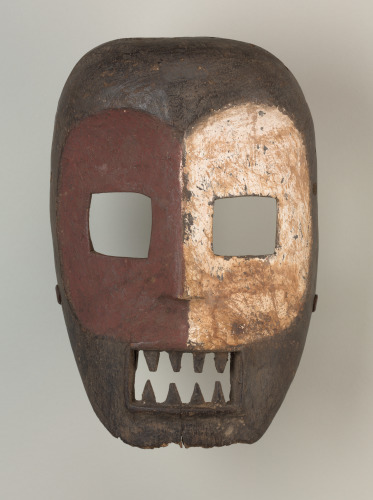
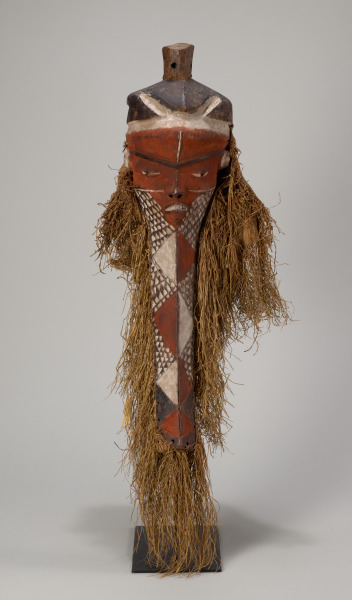
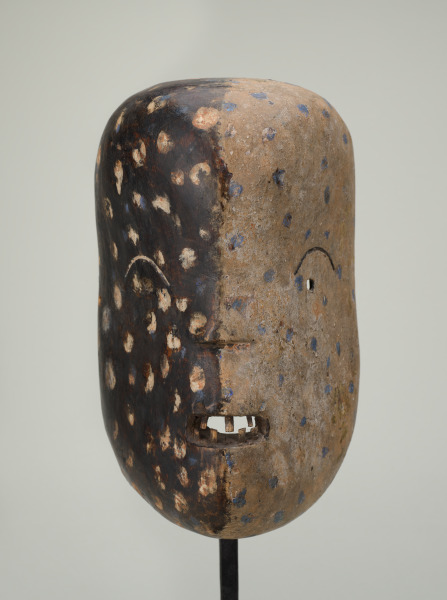
Diviner’s Mask (Ngobudi)
Kongo (Yombe group), 1866-1932
Scroll

Kongo
Diviner’s Mask (Ngobudi)
Kongo (Yombe group), 1866-1932
Physical Qualities
Wood, pigments, plant fibers, fabric, 25.1 x 19.1 x 14.9 cm. (9 7/8 x 7 1/2 x 5 7/8 in.)
Credit Line
Gift of David and Gayle Ackley, Baltimore
Object Number
2010.313
Througout equatorial Africa, ritual specialists mediate with the ancestors and prepare medicines to address the concerns of their clients. While the black, red, and white ngobudi mask was worn only by practitioners specializing in determining the causes of problems, most specialists employed figurative and non-figurative minkisi. The former, dubbed power figures, manifest the partnership between a carver, who created the figure, and the ritual specialist, who rendered the inert sculpture capable of effecting change and healing. The mirror, suggestive of the surface of water, evokes the ancestral realm; Kongo identify bodies of water as the domain of the ancestors. Each iron nail and blade driven into the nkisi nkonde documents a particular case addressed by a ritual specialist.
The Baltimore Museum of Art by gift, 2010; David and Gayle Ackley, Baltimore, Maryland
Karen Milbourne, The Baltimore Museum of Art, "Meditations on African Art: Color," April 18 – August 19, 2007.
Gallery Rotation, Wurtzburger Case 1, July 2008 - present.
Gallery Rotation, Wurtzburger Case 1, July 2008 - present.
BMA. Notecard- Campaign for Art promotion. Summer 2008.
BMA. "In a New Light," Campaign for Art news, Summer 2008, p. 5