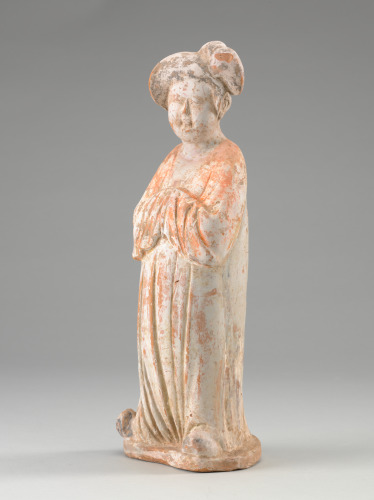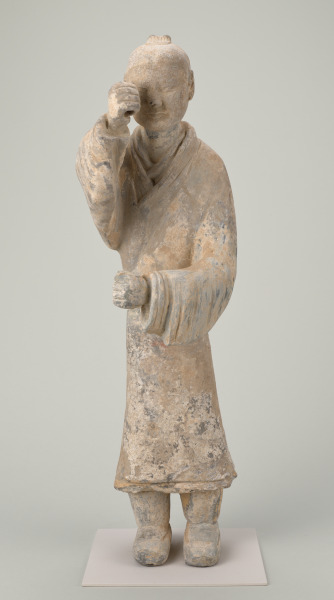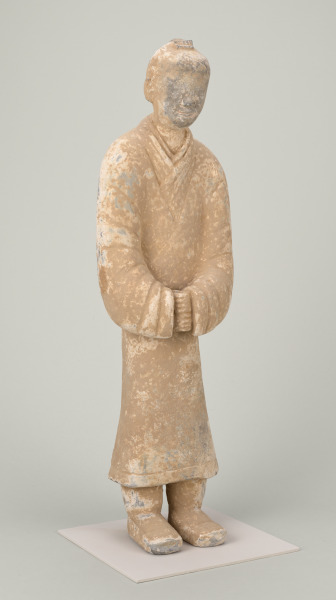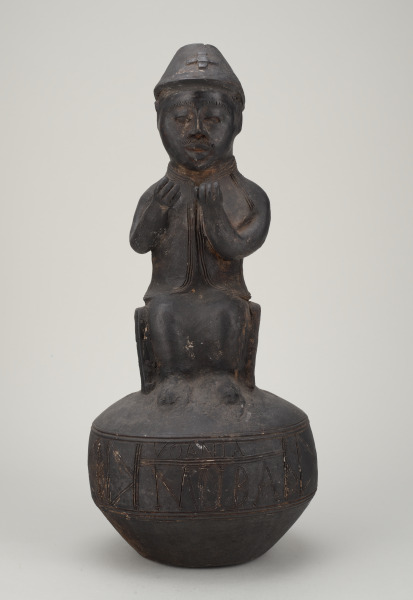






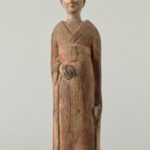
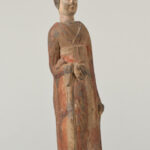
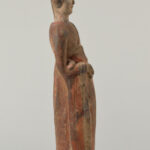
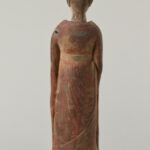
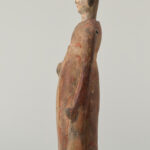

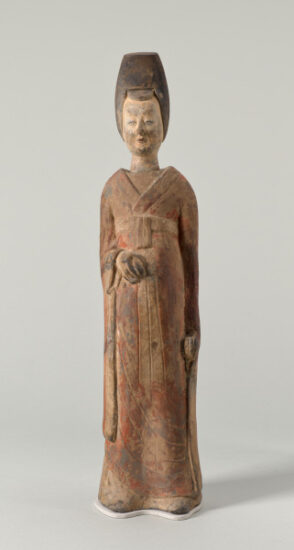
Figure of a Court Attendant
501-533
Physical Qualities
Earthenware with unfired pigment over white slip, 15 x 3 1/2 x 3 1/8 in. (38.1 x 8.9 x 7.9 cm.)
Credit Line
Purchase with exchange funds from Frank J. and Elizabeth L. Goodnow Collection
Object Number
1990.121
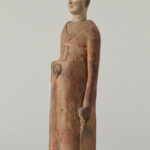
The lacquered gauze “cage hat” on this figure was one of the main headdresses for both men and women of the 3rd through 6th century. Worn over a smaller cap, it was a high, round, flat-topped hat with ear flaps made of stiffened gauze. The figure’s slim body and graceful slouch reflect Buddhist statues of the time. This posture marks a shift away from the strong profiles and stiff gestures characteristic of Han dynasty (206 BCE--220 CE) clay sculpture. A tomb dateable to 525 near Luoyang, Henan Province, contained a group of more than 100 figures like this one.
The Baltimore Museum of Art by purchase, 1990; Sotheby's, New York (no. 15); C. C. Wang Family Collection, New York
Ruth Spelman, "The Arts of China, A Retrospective," C. W. Post Art Gallery, Long Island University, Greenvale, NY, February 4-March 27, 1977, no. 63.
Frances Klapthor, The Baltimore Museum of Art, "Chinese Mortuary Ceramics from the Collection," December 2008-December 2009.
Collection installation, "Asia. Tombs across China: Han Dynasty & Later," Levy Gallery, Baltimore Museum of Art, October 5, 2023-
Frances Klapthor, The Baltimore Museum of Art, "Chinese Mortuary Ceramics from the Collection," December 2008-December 2009.
Collection installation, "Asia. Tombs across China: Han Dynasty & Later," Levy Gallery, Baltimore Museum of Art, October 5, 2023-
Ruth Spelman, "The Arts of China, A Retrospective," Greenvale, NY: C. W. Post Art Gallery, Long Island University, 1977, no. 63, p. 51.
Annette L. Juliano, "Bronze, Clay and Stone," Hong Kong, Hsi An Tang, 1988, no. 32.
 On View at the BMA