





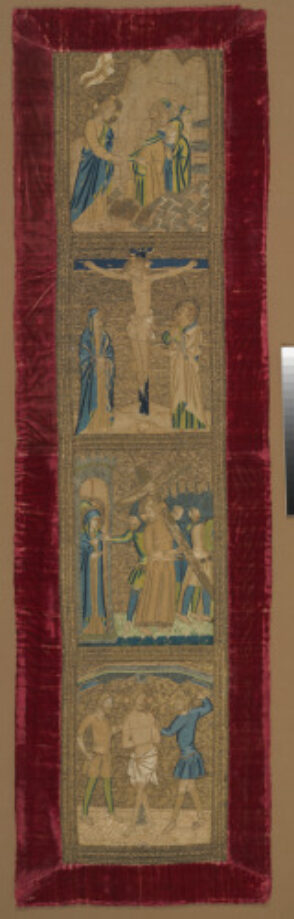
Four Scenes from the Crucifixion of Christ
1300-1399
Physical Qualities
Linen ground, silk, gold and silver metallic-wrapped embroidery threads, silk velvet border, 42 1/4 x 12 in. (107.3 x 30.5 cm.)
Credit Line
Bequest of Saidie A. May
Object Number
2008.86
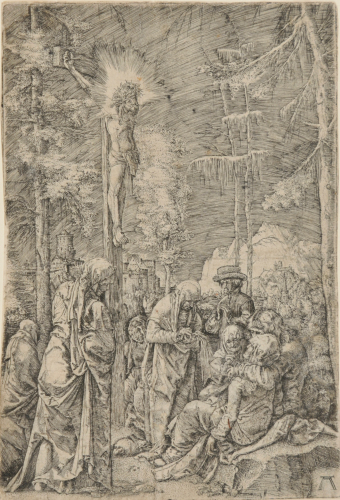
This embroidered band, known as an orphrey, was intended to decorate a priest's vestment, perhaps the sides of a cope (a semi-circular outer cape) or the center front or back of a chasuble (a smaller garment worn at Mass). The band is divided into four sections, each depicting a scene from the story of the Crucifixion of Christ. The first, beginning at the bottom of the orphrey, portrays The Flagellation. The figure of Christ is tied to a column, his body turned toward the viewer in the conventional manner in which this event is rendered. Two men flog him with whips, now difficult to see due to the deterioration of the dark silk threads. In the scene above, Christ carries the cross to the place of execution, while armed soldiers prevent intervention from a female follower. The third scene depicts the Crucifixion in which Christ suffers on the cross. Beneath the cross is a skull, symbolizing the mound called "Golgotha" (commonly translated "place of a skull") on which the cross rests. The under drawing is clearly visible in this area, due to the loss of threads that once embellished the design. The final scene at the top of the orphrey depicts the resurrection of the dead at the time of Last Judgment. Christ greets the dead as they rise from their graves, whereupon the faithful will be granted eternal life.
As with many important works intended for the church and aristocracy, the design of this orphrey might have been supplied by a professional artist, who drew the scenes in charcoal or ink and then passed it to professional embroiderers to be worked. These skilled artisans chose the stitches and materials to accomplish the finished object. Figures were worked in silk threads using mostly split stitches. Buildings, armor, and landscape were rendered in silver threads couched (secured to the surface from the underside of the embroidery) with black or dark silk. The background was covered with gold metallic-wrapped threads laid and couched down in rows. Scrolling vines ending in fleurs-de-lys throughout were created by cords secured beneath the gold surface threads in a manner indicative of the work of Florence, also called opus florentinium.
Baltimore Museum of Art by gift, 2008; Saidie A. May (1879-1951).
Rotation in Jacobs Gallery #6, BMA, December 1, 2008 through September 21, 2009.
Inscribed: Label on reverse of mount prior to conservation mounting: From FREDERICK KEPPEL & CO., Inc. Rare Engravings and Etchings, No. 4 East 39th Street New York.