






Akan
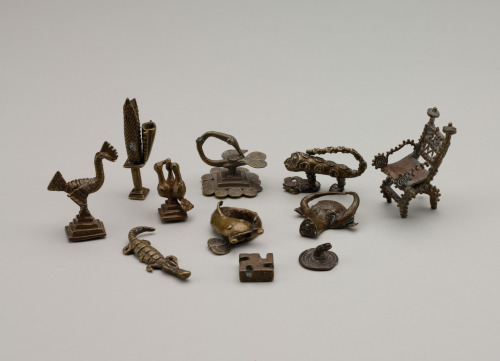
Gold-Dust Weight (Abrammuo)
Akan, 1699-1899
Physical Qualities
Copper Alloy, 1 9/16 x 1 7/16 x 1 5/8 in. (4 x 3.7 x 4.2 cm.)
Credit Line
Gift of Alan Wurtzburger
Object Number
1954.145.31j
Gold made western Africa. Since at least the 7th century CE, this precious commodity enriched civilizations and made the region a critical part of the global economy. Traders moved gold through the Sahara, into northern Africa, and then on to Asia and Europe.
By the 15th century, Asante traders in today's Ghana used Islamic weight standards to develop scales and brass weights that would standardize shipments of gold. Many of these lost-wax cast weights took on designs inspired by old Asante motifs. Others were made in naturalistic forms that referred to Asante proverbs.
(of 31 objects accessioned together, not all exhibited together).
"The Wurztburger Collection of African Art," Jan 12, 1954 - Feb 14, 1954, BMA, cat. 31, illus. p. 20-21.
"Wurtzburger Collection," June 21, 1954 - Aug 31, 1954, (10 selected), School o Advanced Studies, Johns Hopkins University, Washington, D.C.
"NY, African Sculpture," Oct 8, 1954 - Nov 7, 1954, The Memorial Gallery, Rochester.
African Reinstallation, "The Artist," Apr 2015, Wurtzburger Galleries, Kathryn Gunsch.
"The Wurztburger Collection of African Art," Jan 12, 1954 - Feb 14, 1954, BMA, cat. 31, illus. p. 20-21.
"Wurtzburger Collection," June 21, 1954 - Aug 31, 1954, (10 selected), School o Advanced Studies, Johns Hopkins University, Washington, D.C.
"NY, African Sculpture," Oct 8, 1954 - Nov 7, 1954, The Memorial Gallery, Rochester.
African Reinstallation, "The Artist," Apr 2015, Wurtzburger Galleries, Kathryn Gunsch.
Frederick John Lamp, "See the Music Hear the Dance: Rethinking African Art at the Baltimore Museum of Art." New York: Prestel, 2003, p.124, ill.


 On View at the BMA