


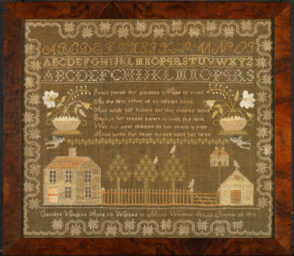
Physical Qualities
Linsey-woolsey ground, silk embroidery threads, 15 1/2 x 17 3/4 in. (39.4 x 45.1 cm.)
Credit Line
Gift of Mrs. Francis White, from the Collection of Mrs. Miles White, Jr.
Object Number
1973.76.387
This sampler is one of the earliest of a large group of Portsmouth samplers which share a common format, including a house and barn with a picket fence, a row of trees, and a birdhouse on a tall pole forming a link between the two. Deceptively simple in appearance, the pattern nevertheless required alphabets, floral, architectural, and figural elements to be worked in various stitches. Mary Walden was one of four schoolmistresses named on samplers of this style, which appear to have originated simultaneously at two different schools, one run by Mary (1799-1885) and her sister Elvira Walden (1802-1883), and another run by Elizabeth and Mary Smith. This sampler pattern was adopted by others and remained popular until at least 1835. Many of these samplers were worked on a dark-green linsey-woolsey ground that contrasted with the once-bright multicolored silk threads.
Baltimore Museum of Art by gift, 1973; Nancy Brewster (Mrs. Frances White) by inheritance; Virginia Purviance Bonsal (Mrs. Miles White, Jr.).
BMA, 'The White Collection,' March 19 - June 2, 1974.
Susan Cumins, BMA,'Period Needlework in America, 1739-1865,' 1978, cat. 18, ill. cover; traveling exhibition circulated to Annapolis, Elkton, Salisbury, Columbia, Leonardtown, Stevenson, and Chestertown, Md.
Anita Jones, BMA, 'The Accomplished Stitch: American Samplers and Silk Embroideries from the Collection,' 5/11-7/20/97 no 25.
Susan Cumins, BMA,'Period Needlework in America, 1739-1865,' 1978, cat. 18, ill. cover; traveling exhibition circulated to Annapolis, Elkton, Salisbury, Columbia, Leonardtown, Stevenson, and Chestertown, Md.
Anita Jones, BMA, 'The Accomplished Stitch: American Samplers and Silk Embroideries from the Collection,' 5/11-7/20/97 no 25.
Ethel Stanwood Bolton and Eva Johnston Coe, Boston: The Massachusetts Society of the Colonial Dames of America, 1921, p. 235, p. 381 mentions the Caroline Vaughan sampler and incorrectly identifies Mary Walden's school as being in Baltimore.
Mary Jaene Edmonds, Samplers & Samplermakers: An American Schoolgirl Art 1700-1850, New York: Rizzoli/Los Angeles County Museum of Art, 1991, p. 78, ftnt. 5.
Betty Ring, Girlhood Embroidery: American Samplers & Pictorial Needlework, 1650-1850, New York: Alfred A. Knopf, 1993, Vol. 1, p. 239, fig. 276.
Inscribed: See Description for complete list of all inscriptions. Embroidered in upper and lower case script letters at the bottom of the sampler: 'Caroline Vaughan Aged 10 Worked at Mary Waldens School October 28, 1818'

Explore the Collection Further