





Pierre Kleykamp and L. Anton Maix Fabrics
Infinity
1949-1952
Scroll

Physical Qualities
Fortisan fiber (rayon), 71 1/4 x 47 in. (181 x 119.4 cm.)
Credit Line
Textile Acquisition Fund
Object Number
2004.74
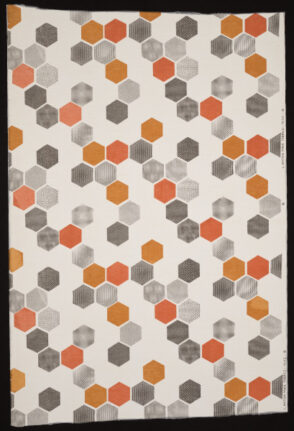
Looking somewhat like a depiction of the molecular structure of carbon, but also reminiscent of a 19th century mosaic quilt, "Infinity" is a design that captures both the 1950s preoccupation with scientific research and its desire for familiar and safe surroundings. Dutch born Pierre Kleykamp was an architect as well as an industrial designer of furniture and fabrics. Kleykamp liked to work with modern materials such as melamine, aluminum, Formica, and linoleum for the interiors he created for Holland American Line and Royal Dutch Airlines. After moving to New York, he became a professor at the Cooper-Union and The New School and worked for Knoll, a leading company in contemporary design of offices and homes. It may have been at Knoll that he first met Lawrence Anton Maix.
A native of New York, Maix had been one of Knoll's early designers and was in some part responsible for helping the fledgling company become established. However, between 1948 and 1950, Maix realized a need for appropriate furnishing textiles for modernist interiors and left Knoll to found his own company, L. Anton Maix Fabrics. Maix hired designers such as Serge Chermayeff, Paul Rand, and Joel Robinson--the latter two winners of the Modern Museum of Art's "Good Design Awards." Throughout the1950s, Maix produced high-quality silkscreen printed textiles, such as "Infinity," designed by Kleykamp and printed on "Fortisan," a now obsolete term referring to a rayon fabric regenerated from cellulose acetate trademarked by the Celanese Company.
Baltimore Museum of Art by purchase, 2004; Giles Kotcher, Somerville, MA.
Battye Gallery extension /Decorative Arts Hallway, Rotation, April 7, 2009-October 26, 2009.
Inscribed: Printed in black on right selvage: "L. ANTON MAIX FABRICS - N.Y.C. - (copyright symbol)"