





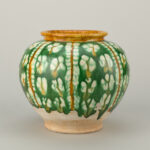
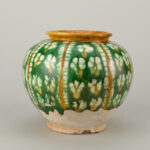

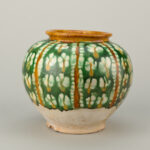
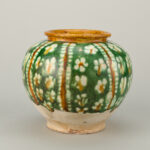

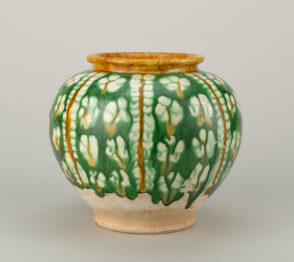
Jar Decorated with Resist Motif
701-733
Physical Qualities
Earthenware with green, amber, and transparent lead glazes over white slip, 7 1/2 × 8 5/8 in. (19.1 × 21.9 cm.)
Credit Line
Julius Levy Memorial Fund
Object Number
1939.242
Lead-glazed earthenwares were generally made to furnish a tomb. The Chinese philosopher Confucius (c. 551-479 BCE) promoted the use of substitute mingqi (luminous objects) for burial.
The Baltimore Museum of Art by purchase, 1939; Parke-Bernet Galleries, Whitridge Collection, Sale #142, Nov. 16-18, 1939; William H. Whitridge, Baltimore; Ralph M. Chait, New York
Walters Art Gallery, January 1950. 'Chinese Ceramics,'
Walters Art Gallery, 4/30-9/15/1956.
Walters Art Gallery, 4/30-9/15/1956.
Whitridge Collection, NY: Parke-Bernet, 1939, no. 266, ill.
A Picture Book, BMA, 1955, p. 90, ill.
Frances Klapthor, 'Chinese Ceramics,' Baltimore: BMA, 1993, no. 11, p. 24, ill. p. 25.
 On View at the BMA