





Yuzhou kilns
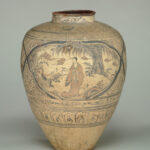
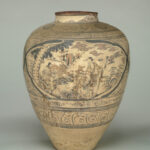
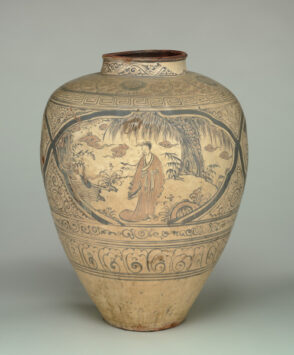
Large Cizhou-Ware Storage Jar Decorated with Three Figural Scenes
1449-1499
Scroll

Yuzhou kilns
Large Cizhou-Ware Storage Jar Decorated with Three Figural Scenes
1449-1499
Physical Qualities
Stoneware with underglaze iron decoration on white slip, 34 H x 26 Diam. in. (86.4 x 66 cm.)
Credit Line
Gift of Ralph M. Chait
Object Number
1929.21.1
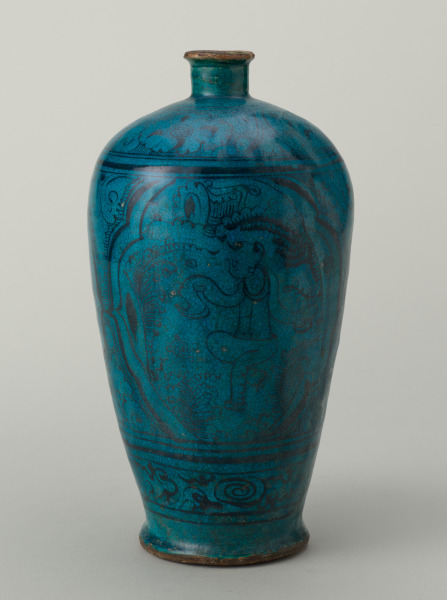
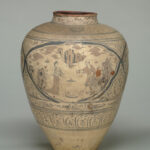
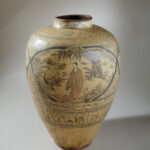
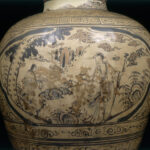
One scene decorating the large vessel comes from "Twenty-four Examples of Filial Piety." It illustrates the story of Guo Zhu, who lived in the 2nd century. Guo was very poor, too poor to provide food for his mother, his son, his wife and himself. In order to have enough for his mother, Guo told his wife, they should kill their son since they could always have another child, but could never have another mother. So, they took the baby out to bury him alive, but when Guo dug the hole in the ground they found enough gold to support all four members of the family. The hole in the ground on this jar contains both cash and dumplings; in Chinese, the word for dumpling shares the same sound as the word for son. The "Twenty-four Examples of Filial Piety" were compiled during the Yuan Dynasty (1279-1368). These moralistic tales were a popular and enduring feature of China's Confucian tradition.
Another scene may depict either a Daoist Immortal, Zongli Quan, or another Confucian exemplar, Xu Yu, one of the Four Philosophers of Miao Gu Shi, admired for his extreme modesty. Zhongli Quan, one of the Eight Immortals, called himself "Chief Vagabond of the World" [Lee, no. 132] and typically carried a double-gourd container holding a magical elixir. In contrast to the "Chief Vagabond of the World," Xu Yu shunned both the world's notice and its pleasures. 'Accustomed to drinking water from his hand, this worthy was given a gourd to use instead. Xu Yu hung the gourd on a tree near his house where the wind whistling through it made a pleasant sound. Because he did not consider himself worthy of this pleasure, he threw the gourd away.' [Ferguson, p. 168] A similar composition of a scholar casting a double-gourd into a river appears also on a pillow, formerly in the Falk Collection now in the collection of the Indianapolis Museum of Art, illustrated in Mino, 1980.
If two of the scenes derive from Confucionist and Daoist sources, it is possible that the third may draw upon popular Buddhism for its subject of a traveler and his attendant in a mountainous landscape.
Each scene is enclosed in a shaped panel or cartouche.
The Baltimore Museum of Art by gift, 1929; Ralph M. Chait, New York
BMA Today, Baltimore: BMA, November - December 2004, p. 13, ill.
Frances Klapthor, Chinese Ceramics, Baltimore: BMA, 1993, no. 31, p. 43.