





Karamojong
Men’s Headdress (Etimat)
Karamojong, 1949-1988
Scroll

Karamojong
Men’s Headdress (Etimat)
Karamojong, 1949-1988
Physical Qualities
Hair, dry mud, pigment, feathers, fiber, metal, glass beads, 13 x 8 1/2 x 11 in. (33 x 21.6 x 27.9 cm.)
Credit Line
Gift of Jonathan and Ellen Maltz, Brookeville, Maryland
Object Number
2013.323
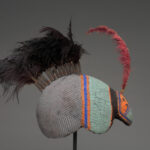
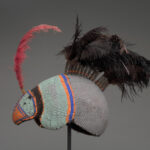
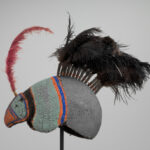
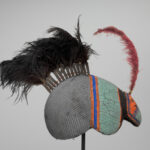
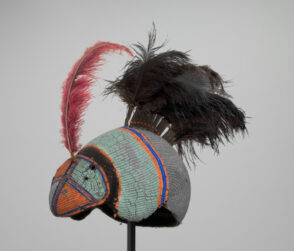
Karamojong men wore elaborate coiffures sculpted with clay into geometric forms until the 1950s, when some men chose to create less cumbersome removable wigs instead. This removable wig allowed elder men to wear a graceful and elaborate coiffure only on special occasions.
The sweeping lines carved into the clay echo the row of feathers above, while the stripe of dark blue and orange paint in the center creates a point of contrast.
The feathers, secured by tightly woven copper coils embedded into the clay, announce the wearer’s accomplishments. In 1971, the Ugandan dictator Idi Amin outlawed traditional Karamojong hairstyles, making a removable headdress a matter of necessity instead of a mere shift in fashion.
The Baltimore Museum of Art by gift, 2013; Jonathan and Ellen Maltz, Brookeville, Maryland, by purchase, 2007; Ignacio A. Villareal, New York
African Reinstallation, "Conspicuous Consumption," April 2015, Wurtzburger Galleries, BMA, Kathryn Gunsch.
"Beyond Flight: Birds in African Art," Dec 20, 2017 - June 17, 2018, BMA, Kevin Tervala.
"Beyond Flight: Birds in African Art," Dec 20, 2017 - June 17, 2018, BMA, Kevin Tervala.


 On View at the BMA