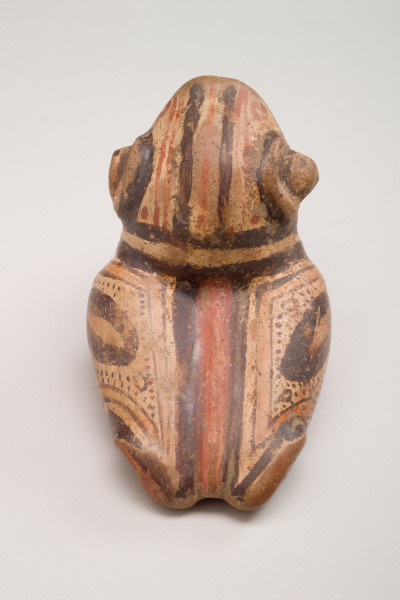








Greater Nicoyan
Pendant
Greater Nicoyan, 300-500
Physical Qualities
Jadeite, 1 1/2 in. (3.8 cm.)
Credit Line
Gift of Alan Wurtzburger
Object Number
1960.30.57
Between 300 B.C. – A.D. 700, Costa Rican stone carvers created miniature forms
of animals that were thought to inhabit the realms of sky, water, and earth. Clockwise from right is a bat with alert ears, an amphibian with tightly folded legs, a double-headed crocodile or caiman with delicate scale-like patterning, and a bird with an arching beak. Carvings of supernatural creatures are also common. The so-called “axe-god” has an avian or anthropomorphic head and a body that imitates the shape of a celt, or cutting tool. These smooth, luminous ornaments are primarily found by archeologists in graves and may have functioned as portable ritual agents that lent prestige to their owners. As important symbolic and trade items, precious jadeite and greenstone objects held powerful spiritual and economic meaning for ancient Costa Ricans.