





Diquís and Chiriquí-Veraguas
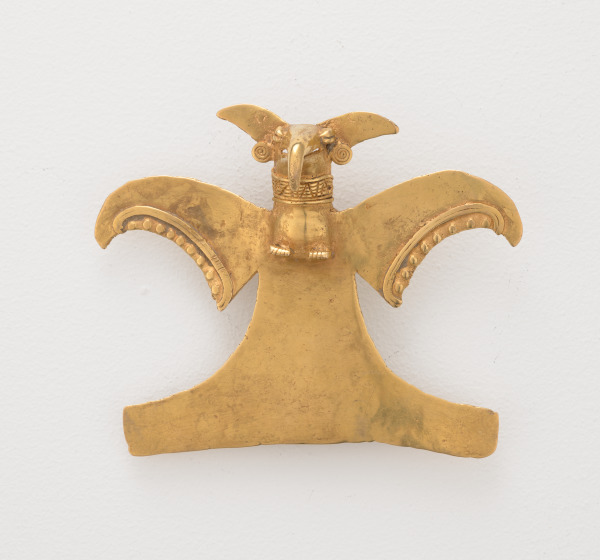
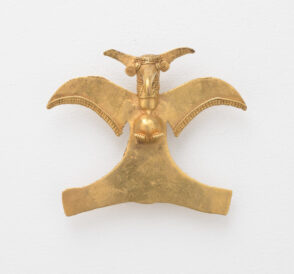
Pendant in the form of an eagle with outstretched wings
Diquis or Chiriquí-Veraguas, 500-1519
Scroll

- Culture: Diquís
- Culture: Chiriquí-Veraguas
Pendant in the form of an eagle with outstretched wings
Diquis or Chiriquí-Veraguas, 500-1519
Physical Qualities
Gold-copper alloy, 4 3/4 in. (12.1 cm.)
Credit Line
Bequest of Alan Wurtzburger
Object Number
1960.30.81
The technology of goldworking thrived in cultures across South and Central America for millennia. Pioneered by artists in the Andes around 2000 BCE, the methods to create gold artworks spread northward via trade networks. Moving along the Andean mountain chain through Colombia, it arrived at the Isthmus region, which includes Panama and Costa Rica, by 100 CE. Intercultural trade spread both the material and manufacturing methods, including a technique that combined gold and copper to create an alloy which could be chemically treated to resemble pure gold.
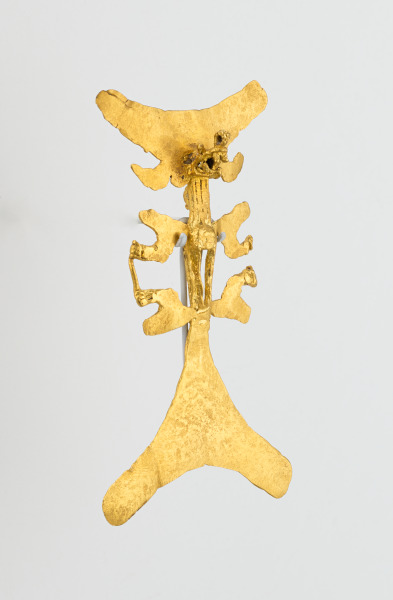
Indigenous people adorned themselves with striking ornaments that communicated prestige, power, and rank. Tolima gold pendants often depicted figures that blend attributes from the human and animal worlds. Scholars believe these figures may represent shamanistic transformations, as shaman healers were thought to transform into animals to interact with the divine. Within Costa Rican goldworking traditions, birds played a prominent role. The Chiriquí-Veraguas and Diquís people often depicted birds of prey whose ability to fly high above and approach the sun would have inspired awe.
Darienne Turner, Baltimore Museum of Art, Ancient Americas Gallery Rotations, December 12, 2021.
Baltimore Museum of Art. The Alan Wurtzburger Collection of Pre-Columbian Art. Baltimore, MD: Baltimore Museum of Art, 1958, no. 81, page 34.


 On View at the BMA