

Physical Qualities
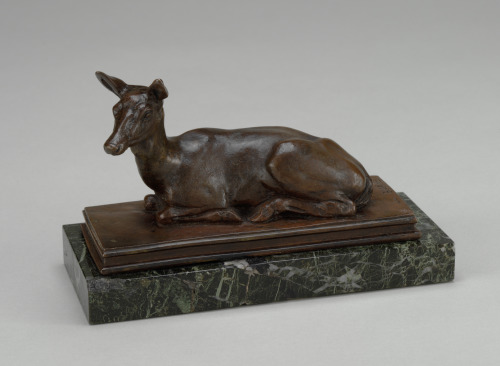
Bronze, brown patina, 4-1/8 H x 6-1/2 L x 3-1/8 D in.
Credit Line
The George A. Lucas Collection, purchased with funds from the State of Maryland, Laurence and Stella Bendann Fund, and contributions from individuals, foundations, and corporations throughout the Baltimore community
Object Number
1996.46.15
A ratel (an African/Asian nocturnal carnivorous mammal--something like a badger) peering into an in-ground nest of eggs at the base of a tree stump. The ratel's proper left fore paw (with claws) is raised over the nest, and its proper right fore paw is resting on the root of a tree stump. Base: oval ground; no rim.
The Baltimore Museum of Art by purchse, 1996; from Maryland Institute, College of Art, Baltimore, by gift, 1910; from Henry Walters, Baltimore, by bequest, 1909; from George Aloysius Lucas, Paris
The North Carolina Museum of Art, Mary Duke Biddle Gallery for the Blind, Raleigh, NC, "Antoine Louis Barye Exhibition", September 1-November 6, 1972.
Memorial Art Gallery of the University of Rochester, Rochester, NY, "Les Animaliers: Antoine Barye and His Followers", January 17-February 23, 1975.
The Baltimore Museum of Art, "Barye: Contrasting Viewpoints", August 12-September 28, 1975.
Memorial Art Gallery of the University of Rochester, Rochester, NY, "Les Animaliers: Antoine Barye and His Followers", January 17-February 23, 1975.
The Baltimore Museum of Art, "Barye: Contrasting Viewpoints", August 12-September 28, 1975.
Inscribed: Side of base: back/proper left, stamped 'BARYE'. Two stickers: L.64.15.16; BMA cat. #343.