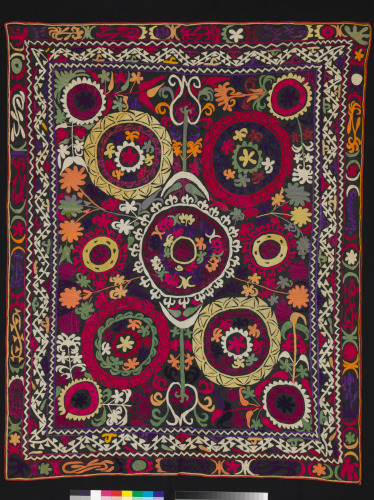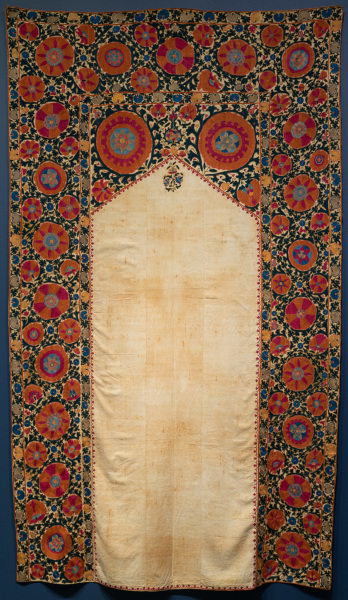






Small Embroidered Hanging or Prayer Mat (nimsuzani or djoinamaz)
1900-1932
Scroll

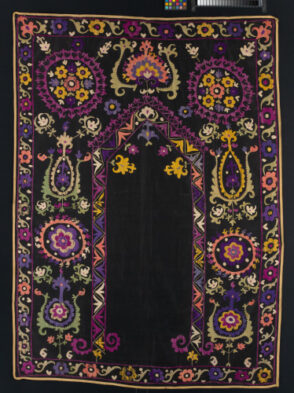
Small Embroidered Hanging or Prayer Mat (nimsuzani or djoinamaz)
1900-1932
Physical Qualities
Cotton ground, silk embroidery threads, cotton backing, 53 x 38 1/4 in. (134.7 x 97.2 cm.)
Credit Line
Gift of Jerry Maizlish, Sparks, Maryland
Object Number
1991.460
In the settled towns of Central Asia, girls began preparing their dowries early, perhaps around the age of seven or eight years old. A child learned basic skills by watching her mother and may also have received additional lessons from an expert. The trousseau had to be beautiful and comprehensive in order to prove the prospective bride's skill, education, and patience, and to reflect well on the reputation of her family. The requirements differed from one region to another, but most families required at least one (or more often two) small hangings in the form of djoinamaz (prayer mats) to be among the dowry textiles. This example emphasizes elaborate vertical floral elements alternating with floral rosettes around the central arch or mihrab. Such hangings may have served secular purposes as well, as covers for storage spaces or decorations for walls. Larger embroidered textiles of similar design, called ruidjo or joipush, were used for sheets on the bridal bed.
Baltimore Museum of Art by gift, 1991; Gerald (Jerry) Maizlish by purchase, c. 1973 Sparks, MD; Afghanistan or Baltimore, MD.
Gamynne Guillotte and Oliver Shell, Joseph Education Center, "Imagining Home," The Baltimore Museum of Art, October 25, 2015- April 10 2016 (1st rotation) and 2017 (3rd rotation??)
Anita Jones, "Embroidered Treasures: Textiles from Central Asia," The Baltimore Museum of Art, November 13, 2011-July 8, 2012.
Anita Jones, "Embroidered Treasures: Textiles from Central Asia," The Baltimore Museum of Art, November 13, 2011-July 8, 2012.
Inscribed: Written in pen on the reverse side, top right corner: ' '