




Henri Matisse and Henri Matisse, Presentation Maquette, Poésies de Stéphane Mallarmé
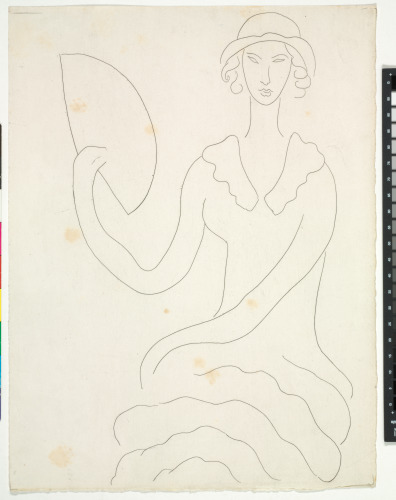
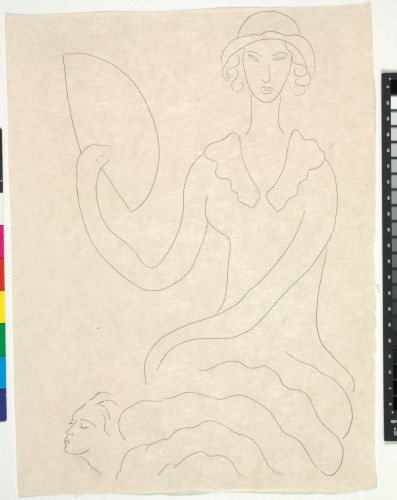
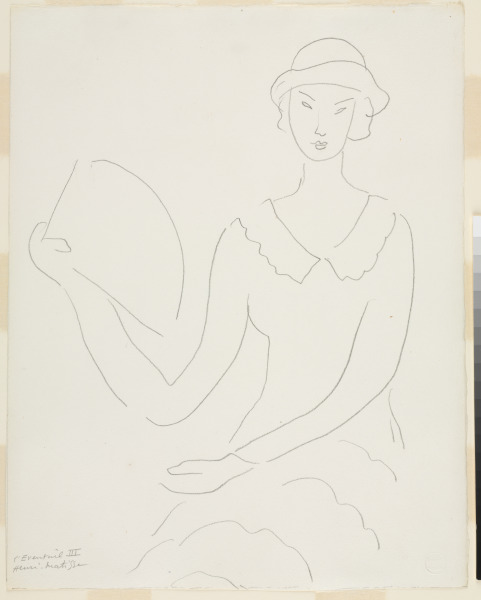
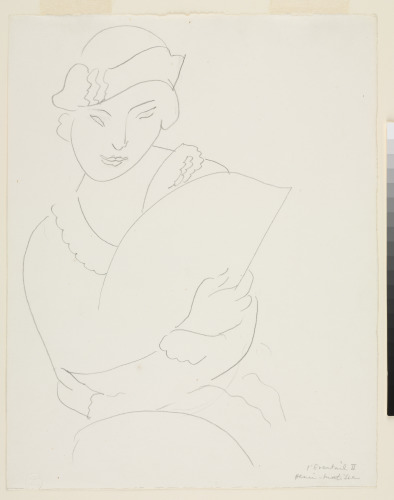
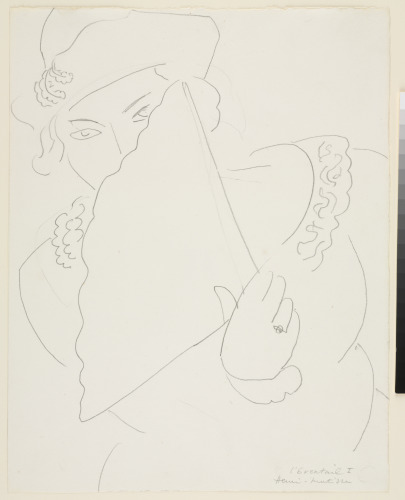
Study for “L’Éventail de Madame Mallarmé” (refused etching)
20th century
Scroll

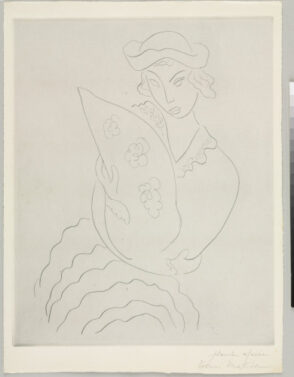
Study for “L’Éventail de Madame Mallarmé” (refused etching)
20th century
Physical Qualities
Etching with plate tone on chine collé, Sheet: 336 x 251 mm. (13 1/4 x 9 7/8 in.)
Plate: 299 x 238 mm. (11 3/4 x 9 3/8 in.)
Credit Line
The Cone Collection, formed by Dr. Claribel Cone and Miss Etta Cone of Baltimore, Maryland
Object Number
1950.12.694.22
The uniform gray background here is partly the result of a residual layer of ink, known as plate tone, left on the printing plate and transferred to the paper during printing. Additionally, the image is printed with narrow margins on chine collé, a French term designating instances when the pressure of the printing press is used to adhere a thin piece of paper, whose edges are just barely visible inside the margins of the lighter colored sheet, onto another heavier weight paper. This example of the artist’s experimentation with print format is unique among the various etchings created for the project. Matisse likely created this print early in the working process, and then abandoned the more elaborate format, deciding it unsuited to the abstracted grandeur of the poet’s verse.
Katy Rothkopf and Leslie Cozzi, The Baltimore Museum of Art, "A Modern Influence: Henry Matisse, Etta Cone, and Baltimore," October 3, 2021 - January 2, 2022.
Guillaud, Maurice, and Jacqueline Guillaud. Matisse: le rythme et la ligne. Paris: Guillaud Editions, 1987, plate no. 633 (published as “L’éventail”).
Cozzi, Leslie and Katherine Rothkopf (eds). "A Modern Influence: Henri Matisse, Etta Cone, and Baltimore." Baltimore: The Baltimore Museum of Art, 2021. ill.
Inscribed: lower right in pencil: "planche refusée / Henri Matisse"
Markings: No WM