




Mau and Worodugu
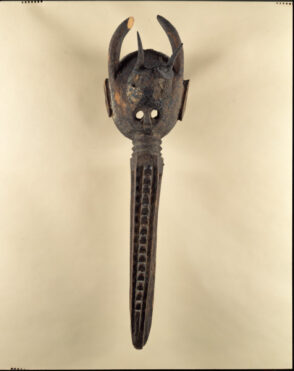
Male Mask Representing a Hyena (Kòmasu)
Mau or Worodugu, 1869-1929
Scroll

Physical Qualities
Wood, goat and sheep horns, fiber, earth, encrustation, iron, copper, 42 5/16 × 11 × 11 1/4 in. (107.5 × 28 × 28.5 cm.)
Credit Line
Gift of Nancy and Robert H. Nooter, Washington, D.C.
Object Number
1985.281
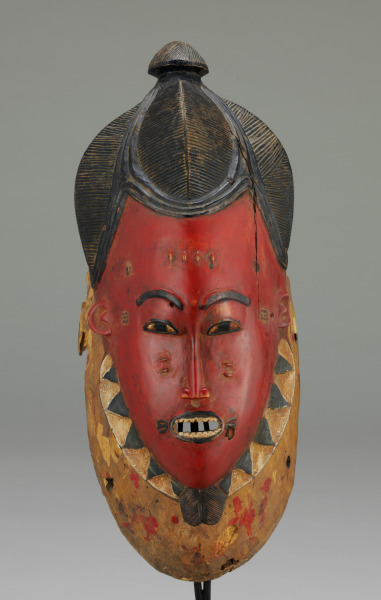
Koma male masks are called "The Hyena." The female version (photo) is "The Great One," and bears a more refined face, long inverted crescent-shaped eyes, and a crested coiffure. The two appear when an antisocial offense has been reported, in order to eliminate the malevolent spirits. The female mask dances inside the village to attract the spirits, and the screaming male races around the outskirts to exterminate them.
Photo:
The Kuhn Collection of African Art, Sotheby's, New York, November 20, 1991.
Obtained in Monrovia, Liberia, in 1966.
Washington Collectors' Show, 1972.
"Odyssey: Jack Whitten Sculpture, 1963-2017," Apr 22, 2018-July 29, 2018, BMA, Kevin Tervala (Head Curator Katy Siegel).
"Odyssey: Jack Whitten Sculpture, 1963-2017," Apr 22, 2018-July 29, 2018, BMA, Kevin Tervala (Head Curator Katy Siegel).
Frederick John Lamp, "See the Music Hear the Dance: Rethinking African Art at the Baltimore Museum of Art." New York: Prestel, 2003, p.237, ill.