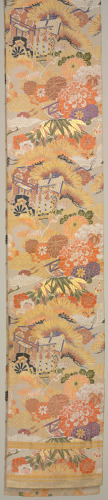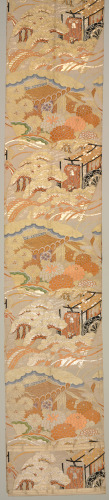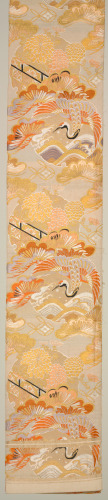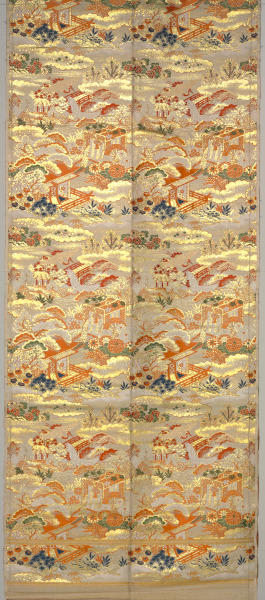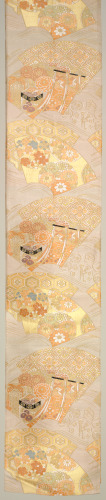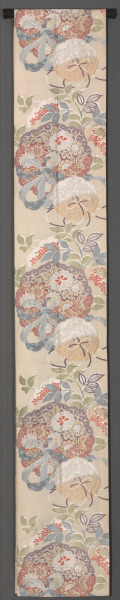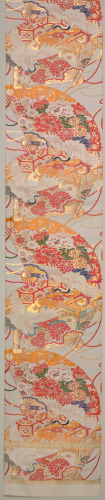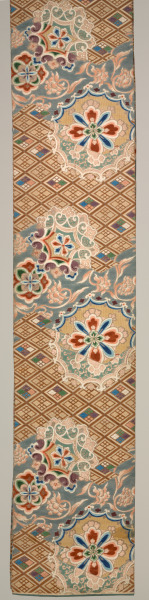







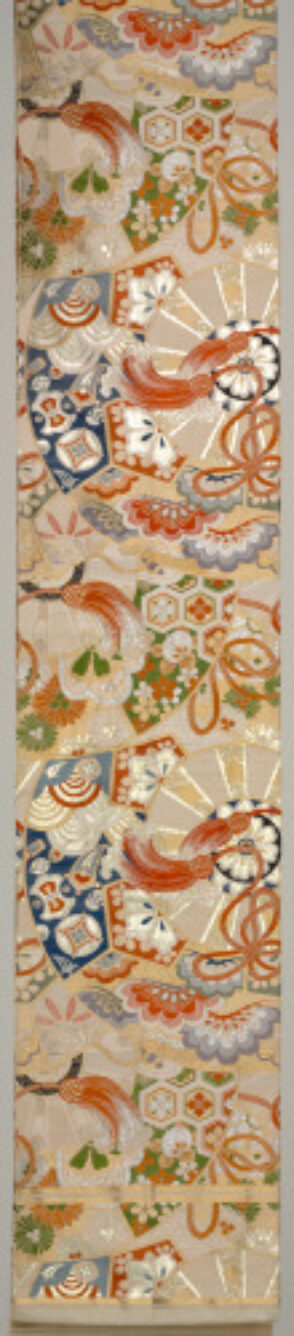
Maru Obi featuring Genji-guruma (Noble’s Carriage Wheels)
1911-1939
Physical Qualities
Silk with supplementary wefts of silk, metal-leafed paper strips, metal-leafed paper strips wrapped around silk or cotton thread core, 166 x 12-7/8 in.
Credit Line
Bequest of Sylvia G. Straton, Rhinebeck, New York
Object Number
2002.687
Label copy for: "Kimono and Obi: Romantic Echoes from Japan's Golden Age," July 10, 2016 - January 15, 2017:
Maru Obi featuring Genji-guruma (Carriage Wheels)
1912–1940, Taisho/Early Showa Eras
Japan
Silk with supplementary wefts of silk, metal-leafed paper strips, and metal-leafed paper strips wrapped around silk or cotton thread core
The ox-pulled carriages (gosho-guruma) of high ranking Heian nobles had two large wheels. These wheels themselves became a decorative motif, Genji-guruma, depicted here overlapping and ornamented with many symbols of good fortune. For example, knotted bows with tasseled ends are scattered throughout this design. Knots are auspicious talismans and have the same significance on Japanese wedding garments as the English term “tying the knot.”
Bequest of Sylvia G. Straton,
Rhinebeck, New York, BMA 2002.687
The Baltimore Museum of Art by bequest , 2002; Sylvia G. Straton, Rhinebeck, New York
Anita Jones and Ann Marie Moeller, The Baltimore Museum of Art, Baltimore, MD, "Kimono and Obi: Romantic Echoes from Japan's Golden Age," July 10, 2016 - January 15, 2017.