





John Needles
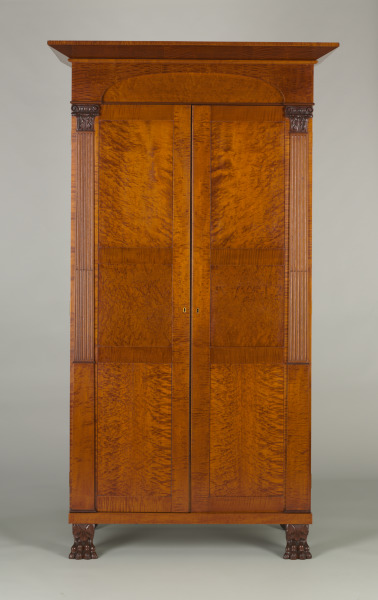
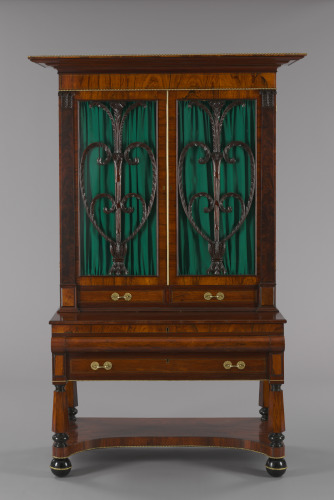
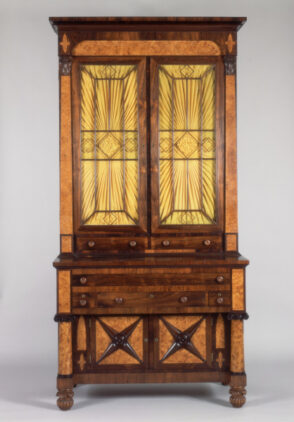
Secretary-Bookcase
1829-1839
Physical Qualities
Mahogany, rosewood, burl maple, white pine, tulip poplar, brass, glass, fabric; replaced baize writing surface, 101 1/2 x 52 1/8 x 27 1/8 in. (257.8 x 132.4 x 68.9 cm.)
Credit Line
Purchase with exchange funds from Gift of Mr. and Mrs. John Engalitcheff, Jr., and Gift of Robert and Jane Meyerhoff
Object Number
1977.36
Large in scale, imposing in form, this secretary-bookcase retains the palette of richly contrasting woods seen in earlier, more delicate Baltimore Federal furniture on view nearby. John Needles adopted French Restoration-inspired elements including a flattened arch in the cornice architrave, pilasters at the sides of the bookcase section, shortened freestanding columnar supports in the base, and four bulbous melon-reeded feet topped with leaf carvings. He gave the piece, labeled with his shop address at 54 Hanover Street in Baltimore, to his first daughter, Mary, possibly as a wedding present.
The Baltimore Museum of Art, by purchase, 1977; by descent to Thomas A. and Jean T. Ladson, Cloverly, Sandy Spring, Maryland, by 1977; Mary Needles Roberts, Sandy Spring, Maryland, 1837.
Gregory R. Weidman, Jennifer Goldsborough, Maryland Historical Society, "Classical Maryland 1815-1845", April 16-September 25, 1993. p. 122.
McCausland, Christianna, "The Last Frontier in Period Furniture." Cheasapeake Home, 46-50, ill.
Elder III, William Voss and Jayne E. Stokes. American Furniture 1680-1880: From the Collection of the Baltimore Museum of Art. Baltimore: Museum of Art, 1987, p.112-113, ill. 81
Inscribed: Inside bottom of top wide drawer of base section is black stenciled label 'John Needles/ Cabinet Maker/ 54 Hanover St/ Balto' in a simple garland wreath.


 On View at the BMA
Explore the Collection Further